At Atelier Drome, we are design curators - with knowledge of and access to both current and timeless designs to complete your space. Our interior design services strive to refine and compliment your ideal aesthetic. Whatever you need to make your home or commercial space feel truly finished, we can help you find that special item you didn't even know was missing.
Aesthetically, lighting fixtures can be like
jewelry for an interior, adding a bit of sparkle and just the right finishing
touch to a space. Functionally, there is a lot more to selecting a fixture than
just its dashing good looks. The right (or wrong) lighting selection will make
or break a design, regardless of how well the rest of the space has been
crafted. Below are five key concepts to understand when selecting the right
fixture.
UL listing
The UL, or Underwriters Laboratories, is an
independent US company that tests and verifies consumer products to ensure
their safety for the public. It is important to select a fixture that has been
tested and approved by the UL, especially if it is going in a bathroom it will need to be UL listed for use in damp locations.
Lamping
Lamping refers to the type of bulb (or lamp)
used in a fixture. Different types of bulbs have different light outputs,
require different amounts of electricity, and have varying lifespans. For example,
LED lights have a much longer lifespan (as much as 10-15 years which is great
for fixtures in locations that are difficult to service) and they are also a
great option for saving on energy costs. Some fixtures can accommodate
different types of bulbs, but others cannot. Be sure to check the
specifications to see whether the fixture uses a bulb that is readily available
in your local store, or whether it is something you will need to special order,
as this will impact the ease of maintenance over time.
Lumens
Lumens are the measurement of light output from
the lamp, or bulb, as mentioned above. We are accustomed to understanding light
output in relation to the watts of an incandescent bulb, but with so many other
options (LED, halogen, fluorescent) a little math is needed to determine light
output: The total output (lumens) you will get from a fixture is equal to the
wattage of the bulb, times the lumens per watt for the bulb type. Therefore, a
60w incandescent that produces about 15 lumens per watt will give off only 900
lumens, whereas a 60w LED that produces 30 lumens per watt will give off 1800
lumens. (Hence the energy savings of switching to LED lights.)
Color Temperature
Color Temperature refers to how visually “warm”
the light output appears. It is measured on the Kelvin scale of 1,000K
(warmest) up to 10,000K (coolest). This influences the “mood” you want to set.
Psychologically, a room filled with “warm” light (2,000K-3,000K) gives a sense
of cozy intimacy and is desirable in restaurants or living rooms. A “cool”
white light (3,000K-4,500K) tends to make a space feel vibrant and bright,
which works well in offices or bathrooms. Daylight falls around 4,600K-6,500K,
which feels energizing and crisp and is great for task lighting.
CRI
Finally, the CRI is the Color Rendering Index,
measured on a scale of 0-100. Different light bulbs (and hence the fixtures
that require them) will vary when it comes to how accurately colors appear
under the light. This is separate from Color Temperature, and gets very
scientific very fast. To simplify the concept, what is important to note when
selecting lighting for spaces where color accuracy is crucial (like a design
studio, salon, or your dressing area at home) is that the higher the CRI
number, the more accurately you will see color. Daylight has a CRI of about 75
and typically in a living space you will want a CRI of 70 or higher.
As you can tell, the art and science of lighting can be very complex,
and we haven’t even touched issues like beam spread or control systems. For
large projects or public buildings where lighting plays a critical role it is
often desirable to engage a lighting consultant. However, understanding these
five key concepts is a great starting point for discussing the basics with your
architect or designer, or shopping for fixtures on your own.
What used to be a teriyaki space in Seattle is now being transformed for our client into Wanderfish Poke. We put together a Mood Board that matches their fast and casual restaurant. The color concept keeps the space fun and exciting for restaurant-goers. We can't wait to share the rest of the design process with you.
One of the first deliverables (and arguably one of the most important) of any design project is a mood board. This collection of inspiration images serves as a visual road map throughout the design process, allowing you and your designer to create a cohesive look & feel (concept) for your space. Inspiration images can be as abstract and seemingly unrelated to architecture as fashion, artwork, food or travel photography. Sometimes, the more unrelated the better as it allows for more creativity to design a truly unique and personalized space. Below are a few inspiration images from a New England concept paired with ideas for how to relate them back to the final design.
To start, the color palette can be derived from one main inspiration image with the look & feel you are going for. Here, it is beachy, light, casual and clean, with lots of blues and soft neutrals.
For example, here we took the weathered wood look from a boat deck and used that as inspiration for the flooring.
Here the color & texture of nautical rope can appear in a chunky knitted throw.
The bathroom fixture on the right was inspired by nautical equipment, both in the design and finish.
The stripes on these boat covers can be referenced through the color and pattern of fabric choices.
The difference between designing bars and restaurants, which we do a lot of, and designing a home (which we also do a good deal of) is that a bar or restaurant is a highly experiential space, while a home is a comfortable, livable space. However, one place in the home that's great for adding a bit of flair is the powder room. It's a small space that can be designed to make a big impression, whether with tile, wall-covering, a funky mirror, unique lighting or a bit of bling. Check out these rooms to get your inspiration going!
Moss walls are the latest interior design fad but their history lies with Buddhist monks in Japan who valued the calming affect of moss that grew in temple gardens. Today, they bring a natural element to the indoors: providing color, a natural escape, and tranquility. Here are some of our favorite ways to use moss walls.
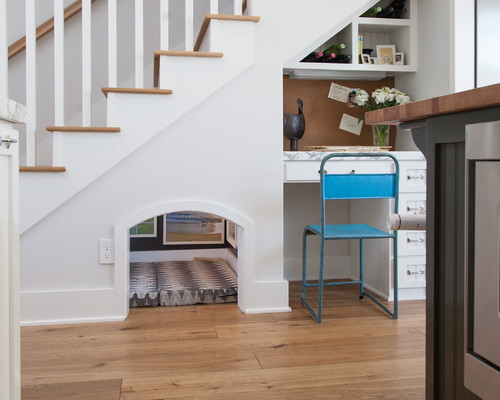
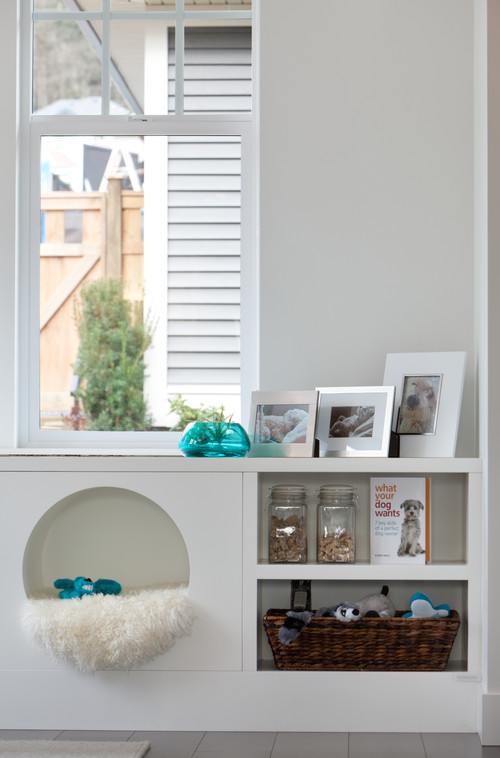
When we're designing a house remodel we like our client to think about everyone who lives in the house, including Fido! Here are some ideas that simplify your life and spoil your furry one.
1. dog wash station


2. food and water dishes incorporated into cabinetry


3. windows at the right height


4. quiet hide-outs
![]() |


Spring is in the air and it is finally time to break out those bright colors. Here are some pops of color for the kitchen and bath to beat out the Seattle gray:
![]() |
Vola faucet in pink
|
![]() |
Vola faucet in orange
|
![]() |
Orange kitchen by VMX architects
|
![]() |
Vola faucet in yellow
|
![]() |
Vola 321 faucet in light green
|
![]() |
Vola faucet in light green
|
![]() |
Silver Lake House, LA CA by Bestor Architecture
|
![]() |
Vola KV-1 faucet in dark blue
|
![]() |
Dornbracht tara faucet in “matt black”
|
According from the stats from Nielsen (2009*), the average American home contains 2.86 televisions. When designing homes, we discuss specific locations and visual prominence of the television early on in the design process.
Do you prefer your television prominently displayed in your home or hidden away until viewing time? Perhaps you live in a condo where the homeowners’ association restricts wall-mounted televisions on a shared wall. Maybe you need the flexibility of pivoting the television or even easily moving it between rooms.
There are many options available to provide secure, convenient and eye pleasing displaying of your televisions. Here are a few that caught our attention:
Do you prefer your television prominently displayed in your home or hidden away until viewing time? Perhaps you live in a condo where the homeowners’ association restricts wall-mounted televisions on a shared wall. Maybe you need the flexibility of pivoting the television or even easily moving it between rooms.
There are many options available to provide secure, convenient and eye pleasing displaying of your televisions. Here are a few that caught our attention:
Floor Mounted
The Sail by Desalto Wall Mounted With Pivot |
Side System Wall Units by FimarMobile |
The Cobra by Mario BelliniHidden |
Riddling Rack TV Cover by Pottery BarnReclaimed |
| Vintage Stand by Etsy |